
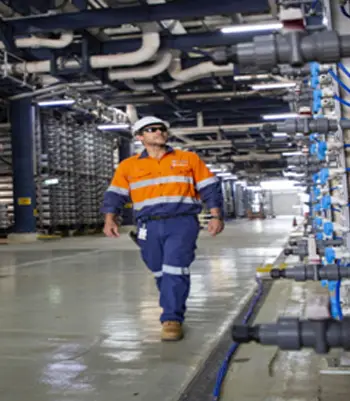
Groundwater treatment is more than a technical process that begins with installing a filter or a desalination plant. It is an engineering decision that starts with an important question: What is hidden in your well water? Water may appear clear as it emerges from the ground, yet contain high concentrations of salts, iron, manganese, turbidity, or contaminants invisible to the naked eye.
In this article, we explore how groundwater is treated, the main methods for reducing groundwater salinity, and common problems found in well water. We also highlight some of the leading names in water treatment in Egypt.
Groundwater is water found beneath the earth’s surface, typically extracted through wells. Groundwater treatment therefore involves treating well water and improving its quality for its intended use, whether for drinking, agriculture, industry, or other projects.
How Aqua Sana Treats Groundwater
The approach to groundwater treatment depends first on water analysis results. Well water may contain dissolved salts, turbidity, silt, bacteria, suspended solids, or other contaminants that affect its quality and suitability for use. The treatment system is therefore selected based on the water source, salinity level, and intended application.
At Aqua Sana, groundwater treatment solutions are tailored to each project’s needs, whether for industrial, agricultural, commercial, or livestock applications. The company also works with different water sources, including municipal water, well water, and seawater.
How Groundwater Is Treated Using Ultrafiltration (UF)
Ultrafiltration (UF) is a membrane treatment technology that passes water under pressure through fine membranes to help remove suspended solids, silt, colloids, bacteria, viruses, and certain microscopic contaminants.
Ultrafiltration is particularly valuable in groundwater treatment when the main concerns are turbidity, impurities, or microbial contamination. It can also serve as a pretreatment stage to protect downstream treatment systems and improve water quality before advanced desalination stages.
Key benefits of ultrafiltration include:
Helping remove suspended solids, silt, and colloids.
Helping reduce bacteria, viruses, and microscopic contaminants.
Providing relatively consistent water quality.
Generally requiring limited chemical use.
Offering ease of operation.
Requiring less installation space than some conventional treatment systems.
However, ultrafiltration is not a substitute for reverse osmosis when dissolved salts are a concern, as it does not reduce salinity as effectively as RO systems.
Learn about: Well Water Desalination Plants for Sale
Reverse Osmosis (RO) for Reducing Groundwater Salinity
Reverse osmosis (RO) is used when groundwater contains high concentrations of dissolved salts or total dissolved solids (TDS). This technology forces water under pressure through a semipermeable membrane that allows water molecules to pass while helping separate out a large proportion of salts, dissolved minerals, bacteria, and microscopic contaminants.
Reverse osmosis is one of the main solutions for reducing groundwater salinity, particularly in well water that requires salt reduction and quality improvement for industrial, agricultural, commercial, or other applications with specific water quality requirements.
The main benefits of RO technology for reducing groundwater salinity include:
Reducing dissolved salt concentrations.
Lowering TDS levels according to the system design and raw water quality.
Removing a large proportion of minerals and microscopic contaminants.
Improving treated water quality for its intended use.
Allowing integration with other treatment stages, such as filtration, ultrafiltration, or disinfection.
How Does Aqua Sana Select the Right Technology to Reduce Groundwater Contamination and Treat It?
Aqua Sana does not use a single technology for every type of groundwater, as each water source has different characteristics. Some cases may require only filtration and ultrafiltration, while others need an RO system to reduce dissolved salts. In other cases, multiple treatment stages must be combined to achieve the required water quality.
Aqua Sana therefore begins by assessing and analyzing the water, then identifying:
The water source: well water, municipal water, or seawater.
Salt and total dissolved solids concentrations.
Turbidity and suspended solids levels.
The presence of bacteria or microscopic contaminants.
The intended use of the treated water.
The appropriate daily capacity for the project.
Based on these findings, a suitable treatment or desalination plant is designed, with capacities ranging from 5 to 10,000 cubic meters per day. The aim is to achieve the best balance between water quality, operating efficiency, and long-term maintenance costs.
Learn more about: Water Desalination Plant Prices in Egypt
Factors to Consider When Choosing the Right Groundwater Treatment System
No single system can treat every type of groundwater. Choosing the right solution depends on the water’s characteristics, its source, and the specific problems it contains. Water analysis should therefore be the first step in identifying salt concentrations, minerals, turbidity, and any contaminants that may affect water quality or safety.
Several factors influence the choice of groundwater treatment system, including:
Geographic location: Groundwater in some areas contains high concentrations of salts or minerals, such as iron and fluoride.
Nearby sources of contamination: These may include chemical leaks, waste, agricultural and industrial activities, and the use of fertilizers and pesticides.
Water analysis results: These determine whether the water requires desalination, filtration, disinfection, or iron and manganese removal.
Intended use: Drinking water requirements differ from those for agriculture, industry, or commercial projects.
Daily water consumption: Treatment plant capacity varies according to the required water volume and project size.
Operating and maintenance costs: A suitable system depends on more than installation alone; ease of operation and efficient long-term maintenance also matter.
For these reasons, a groundwater treatment system or desalination plant should not be installed without a proper assessment. The water must first be tested to identify the problem accurately, then an appropriate system selected to ensure water quality, protect equipment, and achieve optimal operating efficiency.
Aqua Sana: A Leading Name Among Water Treatment Companies in Egypt
When choosing among water treatment companies in Egypt, it is not enough to rely on a standard system or a desalination plant installed without prior assessment. Well water varies from one area to another in salinity, turbidity, iron and manganese concentrations, and intended use. Aqua Sana therefore provides solutions designed around water assessment and analysis, rather than applying the same solution to every project.
Aqua Sana can help you with:
Analyzing water characteristics and identifying salt, turbidity, iron, and manganese levels.
Selecting the appropriate groundwater treatment approach based on the water source and salinity.
Designing RO desalination and purification plants when needed.
Selecting pretreatment stages, such as sediment filters, carbon filters, and iron removal systems.
Determining the appropriate plant capacity based on daily water consumption.
Providing solutions for residential, agricultural, industrial, and commercial projects.
Supporting operation and maintenance to preserve long-term system efficiency.
If you are looking for groundwater or well water treatment, Aqua Sana can help you obtain a system designed around your water’s characteristics and your project’s needs.
Ultimately, groundwater treatment begins with understanding the characteristics of well water through analysis, followed by selecting the appropriate treatment system based on salinity, turbidity, the presence of iron or manganese, and the intended use. Every water source has different characteristics, and every project requires a solution tailored to its actual needs.
Contact Aqua Sana today for a technical assessment and a complete groundwater treatment solution, from water analysis through to the design and implementation of a system suited to your project.