
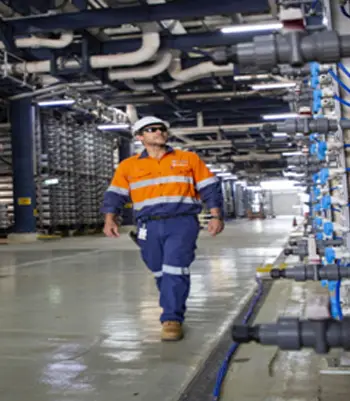
Does relying on external water sources hinder the growth of your coastal project or increase operating costs? In the hotel, resort, and industrial sectors, seawater desalination plants in Egypt have become a strategic solution for achieving complete water independence.
However, the question is not only, “How does the plant work?” It is also, “How can you achieve the highest productivity at the lowest seawater desalination plant cost?” In this article, we provide a decision-making guide. We explore the technical differences between desalination technologies, explain the real factors affecting the cost of small and large desalination plants, and show how Aqua Sana can turn this investment into a long-term asset that serves your project for decades.
You will also learn about RO water desalination plants and discover how we design a customized system that ensures operating efficiency, rather than relying on ready-made solutions that may not suit your specific needs.
Why Seawater Desalination Plants Are Important in Egypt
Seawater desalination plants in Egypt have become important solutions for providing water to coastal, tourism, and industrial projects, especially as the need for reliable, year-round water sources continues to increase.
These plants treat seawater and remove salts and impurities, making it suitable for use according to the needs of each project, whether in hotels, tourist villages, factories, or new cities.
Reasons for Growing Reliance on Seawater Desalination
The continued expansion of tourism and urban-development projects along Egypt’s coasts.
The need for hotels and tourist resorts to have a stable water source throughout the year, particularly during peak operating seasons.
Growing water demand from factories and industrial projects located near the sea.
The difficulty of relying completely on conventional water sources in certain coastal areas.
The availability of seawater as a nearby source that can be utilized when the desalination plant is properly engineered.
Project owners’ desire to control water quality and daily production quantities rather than depend on variable external solutions.
Reduced risk of operational disruptions resulting from weak or irregular alternative water sources.
This is where specialized companies such as Aqua Sana play a role—not only by supplying seawater desalination plants in Egypt, but also by studying the project from the beginning, including the water source, consumption volume, required water quality, and suitable operating method.
Seawater Desalination Technologies
Seawater desalination plants in Egypt rely on several systems that work together to remove salts and impurities and improve water quality. These systems begin with pre-treatment stages and then move to desalination and chemical-treatment technologies to ensure efficient operation.
Reverse Osmosis (RO)
Reverse osmosis provides effective seawater desalination by removing a large percentage of salts and impurities through fine membranes.
It is one of the most widely used water desalination technologies. Seawater passes through semi-permeable membranes that allow water to pass while blocking salts and unwanted particles. This produces water with lower salinity that is more suitable for different applications.
Ultrafiltration (UF)
Ultrafiltration helps protect desalination systems by removing suspended materials before water reaches the final treatment stages.
It is used as an important pre-treatment stage because it reduces impurities and fine particles in water. It also reduces the load on reverse osmosis membranes, improving operating efficiency and extending equipment life.
Media Filters
Media filters improve water quality by reducing turbidity and removing particles and suspended solids.
This technology uses multi-media filters to purify water before it enters advanced treatment stages. It is a core solution in water-treatment systems, particularly when water contains sediments or impurities that may affect system efficiency.
Chemical Dosing Systems
Chemical dosing systems help control water quality by managing scaling and microbial growth within the system.
These systems add specific chemicals in calculated quantities, such as antiscalants and pH stabilizers. This helps protect membranes, pipes, and equipment from clogging or corrosion while maintaining stable desalination-system performance.
Reverse Osmosis Stages for Seawater Desalination
Reverse osmosis stages help remove salts and impurities from seawater while protecting membranes and improving operating efficiency.
The seawater desalination process goes through several consecutive stages. It begins with raw-water intake and the removal of large impurities, followed by water preparation before it enters the membranes. The water is then pressurized to separate salts and produce desalinated water.
Seawater Intake and Initial Filtration
This stage removes large materials such as algae, shells, sediments, and suspended solids before water enters the plant.
Pre-Treatment
This stage reduces turbidity, organic matter, and microorganisms that may clog RO membranes.
Coagulation and Sedimentation
Chemicals are added to combine fine impurities into larger particles that can be separated more easily from the water.
Media and Sand Filtration
This stage removes smaller particles and residual turbidity after sedimentation.
Cartridge Filters
These serve as a final protection stage before the membranes, preventing fine particles from passing through and affecting system efficiency.
High-Pressure Pumps
High-pressure pumps force water through RO membranes to separate salts from water.
Reverse Osmosis Membranes
These are the core of the system. They allow water to pass while blocking a large percentage of salts and impurities.
Energy Recovery
Energy-recovery systems reduce electricity consumption by utilizing the pressure of saline water leaving the system.
Post-Treatment and Disinfection
This stage adjusts produced-water quality, improves its taste, and disinfects it before storage or distribution.
Operating Quality Monitoring
Pressure, flow rate, salinity, turbidity, and temperature are monitored to ensure stable plant performance.
This highlights the importance of correct design from the beginning, as each stage directly affects the next. Aqua Sana studies the water source, required capacity, and intended application before designing a desalination plant to ensure efficient and stable long-term operation.
How Aqua Sana RO Desalination Plants Work
Aqua Sana uses reverse osmosis technology in the implementation of RO water desalination plants. It is among the most efficient technologies worldwide for converting saline water into high-quality fresh water.
The process relies on applying hydraulic pressure greater than the natural osmotic pressure to force water through fine semi-permeable membranes.
RO Membrane Performance
Reverse osmosis membranes have a high ability to separate contaminants based on particle size and charge. They can remove up to 99% of dissolved salts (TDS), bacteria, colloidal materials, and pyrogens.
This technical advantage makes RO an ideal solution for hotels, tourist resorts, factories, and agricultural projects that require exceptionally pure water.
Uses of Seawater Desalination Plants
Seawater desalination plants are especially important in coastal areas, where the sea is a nearby source but requires precise treatment before the water can suit each intended use.
Hotels and Tourist Villages
To provide water for rooms, kitchens, laundries, swimming pools, cleaning, and daily service operations.
Factories and Industrial Projects
To provide suitable water for operations, cooling, washing, and certain production lines, depending on the industry.
New Cities and Urban Communities
To support infrastructure and provide a stable water source in coastal areas.
Agricultural Projects Near the Coast
To use treated water for irrigation after adjusting its quality to suit soil type and crops.
Commercial and Service Facilities
Such as resorts, malls, and service centers that require consistent daily water quantities.
Ships and Marine Facilities
Through desalination units designed for limited spaces and marine operating conditions.
Aqua Sana helps determine the appropriate plant design based on the intended application, as the needs of a tourist hotel differ from those of a factory or agricultural project in terms of water quality, production volume, and daily operating system.
Factors Affecting Seawater Desalination Plant Cost
The cost of a seawater desalination plant in Egypt varies according to the nature of each project. Plants are not priced based on equipment alone, but according to design, capacity, and required water quality.
The same applies when looking for the cost of a small desalination plant. Even small plants require an assessment of the water source, salinity level, and consumption volume before a final price can be determined.
Main Cost Factors
Required daily production capacity.
Seawater salinity level or the characteristics of the selected water source.
Type and quality of filters, membranes, and pumps.
Level of control and monitoring systems.
Electricity, chemical, and maintenance costs.
Site conditions, water-intake method, and brine-disposal method.
Required post-treatment water quality.
Aqua Sana incorporates these factors into the design of seawater desalination plants in Egypt through a precise assessment of the water source, required capacity, component quality, and operating system. This helps reduce operating costs and achieve stable performance suited to your project.
Why Choose Aqua Sana?
We offer an integrated engineering partnership built on more than 30 years of experience in the Egyptian market. At Aqua Sana, our role is to transform your project from an idea into a highly efficient operating system.
Detailed Engineering Design
We do not rely on ready-made solutions. We begin with a precise analysis of water characteristics, including salinity, turbidity, and impurities, to design the ideal pre-treatment stage that protects RO membranes and ensures their long-term performance.
Compatible Global Technology
We select high-quality membranes and pumps, and precisely configure control and chemical-dosing systems according to your required production capacity, ensuring the lowest possible operating cost.
Complete Project Management
We take full responsibility, from technical study and feasibility assessment through supply and installation to operation and periodic maintenance, ensuring stable performance for years.
Specialized Team
We rely on extensive engineering experience in designing and operating desalination plants for tourism, industrial, and municipal sectors, making us a trusted partner for implementing your plant to global efficiency standards.
Aqua Sana: Three decades of experience in transforming water into a sustainable resource for your project.
Seawater desalination plants in Egypt are no longer merely an alternative water-supply solution. They have become an essential factor in the success and continuity of many coastal, tourism, and industrial projects.
Contact Aqua Sana today to obtain a technical study tailored to your project and identify the best seawater desalination solution based on the water source, required capacity, and intended use.