
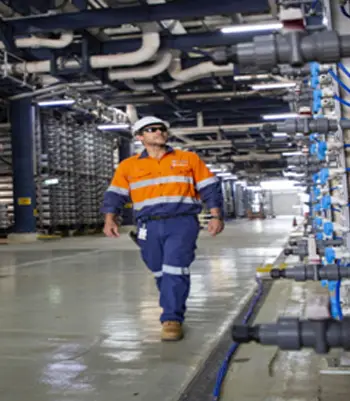
In industrial and tourism sectors, having a water purification plant is essential for maintaining production continuity and protecting assets. Raw water from different sources can present complex technical challenges, such as turbidity and high salinity levels. Relying on standardized, non-customized solutions can be costly and may lead to recurring failures and production-line shutdowns.
In this article, we explain how a drinking water purification plant works, the essential components that ensure efficient operation, and the factors that affect the cost of establishing a water purification plant. Most importantly, we explain why choosing a specialized engineering partner among water purification companies in Egypt is the true guarantee of protecting your investment and equipment in the long term.
Drinking Water Purification Plant Components
A drinking water purification plant requires precise engineering design that combines equipment efficiency with sustainable operation. At Aqua Sana, we implement drinking water purification projects through integrated technical systems that transform raw water into water that meets international health standards.
Water Intake Unit
This is the starting point for drawing water from the natural source. It is equipped with coarse screens to retain large suspended materials.
Chemical Treatment Unit
This unit uses specialized chemicals, such as coagulants, to remove turbidity and mud deposits.
Fine Filtration Unit
We use multiple filtration media, including sand and activated carbon, to remove fine impurities and suspended particles.
Desalination Unit
When well water requires special treatment, we integrate advanced desalination technologies, such as reverse osmosis, to remove excess salts.
The price of a well-water desalination plant varies according to the required technical specifications. Aqua Sana helps determine this accurately through a comprehensive technical study.
Disinfection and Sterilization Unit
We use ultraviolet (UV) treatment or carefully controlled chemical disinfection to eliminate bacteria and viruses while adjusting pH levels.
Automated Control and Monitoring System
This is the “brain” of the plant. Intelligent systems monitor water quality and performance in real time, helping reduce the long-term cost of both small and large desalination plants by improving consumption efficiency.
Whether you are looking to implement water desalination plants in Egypt to standard specifications or need a fully integrated drinking water purification plant for your facility, Aqua Sana provides technical studies, high-quality components, and ongoing technical support.
Do you need a water purification plant designed for your requirements? Contact Aqua Sana and let our engineers develop the optimal technical and financial plan for your project.
Why Do Projects Need Water Purification Plants?
Different projects require water purification plants because water quality directly affects operating efficiency, user safety, equipment life, and—in some industries—the quality of the final product.
Untreated water may contain high levels of salts, iron, manganese, turbidity, bacteria, chlorine, or fine impurities. These elements can cause pipe blockages, equipment damage, changes in water taste or odor, deposits in boilers or production lines, and water that fails to meet required specifications.
Importance of Drinking Water Purification Plants
Protecting equipment from scale buildup and corrosion.
Improving the quality of water used for drinking or operations.
Reducing failures caused by salts and impurities.
Providing water suitable for industrial and service applications.
Supporting projects that need consistent and stable water quality.
For this reason, water purification plants should not be selected randomly. The design must be based on water analysis, contaminant identification, daily consumption volume, and the intended use of the treated water.
Drinking Water Purification Stages
Drinking water is purified in water purification plants in Egypt through several consecutive stages intended to remove impurities, suspended solids, and contaminants that may affect water quality or make it unsuitable for human use.
Screening
Large impurities and solid materials that may obstruct pumps or affect the efficiency of later treatment stages are removed.
Coagulation
Chemicals, such as aluminum sulfate, are added to help collect fine particles and suspended materials that are difficult to settle naturally.
Flocculation
Fine impurities are formed into larger clusters so they can be separated from the water more easily during sedimentation.
Sedimentation
Heavy materials and collected impurities settle at the bottom of basins, producing clearer water with fewer deposits.
Filtration
Water passes through filtration systems to remove fine sediments and residual impurities, such as sand and suspended particles not removed in earlier stages.
Disinfection
This final stage eliminates harmful bacteria and microorganisms using chlorine, ozone, or ultraviolet light.
Reverse Osmosis in Water Purification Plants
Reverse osmosis is an advanced water purification technology that passes water under pressure through semi-permeable membranes. These membranes allow water molecules to pass while separating a large percentage of dissolved salts, heavy metals, fine impurities, and some contaminants.
RO systems are used in water purification plants when water requires salinity reduction or a higher level of treatment. They are important in drinking water plants, industrial water plants, and applications that require water with specific purity levels.
However, reverse osmosis systems should not be installed without a technical study. RO membranes need protection from turbidity, chlorine, scaling, and iron. Suitable pre-treatment stages—such as sand filters, carbon filters, softening units, or antiscalant systems—must be installed based on water conditions.
Benefits of Reverse Osmosis
Reducing dissolved salt levels in water.
Improving produced-water quality.
Removing a large portion of fine contaminants.
Providing suitable water for certain industrial and service applications.
Improving taste and reducing impurities in drinking water.
Reverse osmosis efficiency varies according to raw-water quality, membrane type, operating pressure, and the performance of pre-treatment stages.
Cost Considerations for Water Purification Plants
When planning a drinking water purification plant project, costs are an essential decision-making factor. The cost includes a comprehensive study of technical and operational requirements that ensure project continuity and profitability.
Sustainable Energy Sources
The plant should have a reliable energy source, whether through connection to the public grid or renewable-energy solutions, to reduce the cost of small or large desalination plants.
Specialized Technical Staff
Qualified engineers and maintenance technicians are required to handle advanced reverse osmosis technologies.
Environmental Discharge Plan
Safe solutions must be developed for the disposal of generated brine, particularly in seawater desalination plants in Egypt.
At Aqua Sana, we help balance quality and cost. We provide precise technical and financial feasibility studies that help estimate the cost of small or large desalination plants and design systems that reduce long-term operating bills, supporting faster capital recovery and investment-asset protection.
Types of Water Treatment Plants
Water plant types are determined by the water source and the purpose of treatment. At Aqua Sana, we design solutions that ensure high water quality and low operating costs.
Water Desalination Plants
These plants convert seawater or saline well water into fresh water. Our technologies focus on reducing energy consumption to provide the best long-term well-water desalination plant value.
Water Purification Plants
These are designed to treat river and lake water by removing impurities and turbidity, providing water that meets health specifications for industrial or drinking purposes.
Drinking Water Treatment Plants
These plants are designed specifically for residential communities and large projects, producing water that meets international health standards through precise filtration and disinfection stages.
Wastewater Reuse Treatment Plants
These are economical and sustainable solutions for treating industrial or domestic wastewater and reusing it for irrigation or cooling.
We do not simply supply systems. We design and implement engineering solutions that achieve your goals with high operating efficiency and the lowest possible cost.
Why Choose Aqua Sana?
When searching for water purification companies in Egypt, it is important to choose a company with technical expertise in water analysis and plant design—not one that only supplies ready-made equipment.
A water purification plant is an integrated system that requires analysis, design, implementation, operation, and maintenance to ensure optimal performance.
Aqua Sana Services
Aqua Sana provides integrated water purification and treatment solutions by studying water characteristics and project requirements, then designing a suitable plant that balances water quality, implementation cost, and operating stability.
Our services include:
Water analysis and assessment before selecting a system.
Designing water purification plants according to the needs of each project.
Supplying and installing drinking water and industrial water purification systems.
Selecting suitable filters, pumps, and membranes.
Implementing reverse osmosis systems when required.
Operating and maintaining plants after installation.
Upgrading and refurbishing existing plants to improve efficiency.
Providing suitable solutions for factories, hotels, tourist villages, and commercial projects.
If you are looking for a water purification plant for your project, relying on a specialized company such as Aqua Sana helps you obtain a carefully engineered system designed around your actual needs and capable of delivering stable water quality in the long term.
Contact Aqua Sana today for a complete technical study and a drinking water purification plant design suited to your project and operating requirements.