
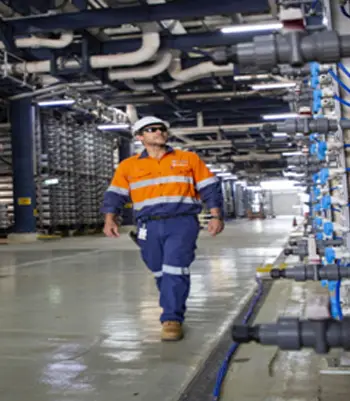
Water purification plant prices vary significantly from one project to another. The true cost involves more than equipment; it reflects an engineering design based on raw water quality, daily consumption, and the purpose of treatment. A factory or hotel therefore has different requirements from a farm or villa.
At Aqua Sana, we understand that choosing the right system begins with understanding modern technologies, such as ultrafiltration, which has become an ideal option thanks to its efficiency in removing impurities and microorganisms while preserving the water’s beneficial mineral composition.
Drawing on our experience, we explain why Aqua Sana is your ideal partner for selecting a system that balances water quality and operating efficiency, turning your investment in water purification into a successful, sustainable operational asset.
What Determines Water Purification Plant Prices?
There is no single price that applies to all water purification plants. The final cost results from a technical assessment rather than simply purchasing ready-made equipment. The total project cost depends on several technical factors that our experts carefully evaluate:
Raw water type and characteristics: Water analysis guides the process. Water with high turbidity and impurity levels requires different treatment equipment from water containing heavy metals or high salinity.
Production capacity: The volume of water required per day or hour is the main factor determining the size of the equipment and the membranes needed.
Component quality: The pumps, membranes, and electronic control systems used directly affect performance efficiency and the plant’s service life.
Intended use: Water purification requirements for industrial or agricultural use differ from those for drinking water, according to the applicable health standards.
At Aqua Sana, we carefully analyze these factors before providing a quotation. This ensures that your plant delivers optimal performance and efficiency without the added cost of components your project does not need.
Does your project require a detailed technical assessment? Contact our engineering team today for a study tailored to your project’s requirements and a carefully prepared water purification plant quotation to set you on the right path.
What Is Ultrafiltration Technology?
Ultrafiltration is one of the advanced solutions we use at Aqua Sana to produce highly purified water. The process uses hydrostatic pressure to force water through semipermeable membranes with extremely fine pores, ranging from 0.005 to 0.02 microns. These membranes form a strong physical barrier against contaminants and suspended solids.
The technology uses hollow-fiber membranes. Feed water passes through the membrane under carefully controlled pressure, retaining solids, bacteria, viruses, and high-molecular-weight particles while allowing water and dissolved minerals to pass through.
A defining feature of our ultrafiltration systems is their strategic integration with other purification technologies to ensure the complete removal of colloids, pyrogens—fever-causing substances—and fine particles.
Benefits of Ultrafiltration Systems
This technology is an ideal choice for projects seeking competitive water purification plant prices, sustainability, and efficiency. Its benefits include:
Environmentally friendly operation: A physical process that does not require the addition of chemicals such as coagulants, disinfectants, or pH-adjusting agents.
Consistent water quality: High-quality output in terms of clarity and freedom from microorganisms.
Space efficiency: Our designs require limited installation space and provide flexibility for access and operation.
Ease of management: Systems are simple to operate and require less complex maintenance.
What Is the Difference Between Ultrafiltration and Reverse Osmosis?
Our customers frequently ask about the difference between these technologies. Simply put, the distinction lies in the treatment objective:
Ultrafiltration (UF): The ideal solution when the goal is to purify water by removing impurities and microorganisms while retaining natural salts and minerals. It operates directly without requiring large storage tanks.
Reverse osmosis (RO): The ideal solution when the goal is to desalinate water by completely removing salts to obtain highly purified, demineralized water. This process typically requires higher pressure and collection tanks.
Do you only need to remove suspended solids and microorganisms, or do you need demineralized water for sensitive industrial processes? Our engineering team will identify the most suitable system to deliver maximum efficiency at the best cost.
Consult our engineers today to select the right drinking water purification plant system for your project.
What Does Ultrafiltration Remove from Water?
Ultrafiltration acts as a physical guardian of water quality in our plants, offering a high capacity to remove microscopic contaminants and suspended matter. The system effectively removes:
Microorganisms: Removes 99.99% of bacteria, along with viruses, protozoa such as Giardia, and parasites.
Suspended solids and impurities: Removes suspended solids, silt, turbidity, and colloidal matter.
Organic compounds: Retains high-molecular-weight organic molecules.
Heavy metals: Removes a substantial proportion of heavy metals that are organically bound or attached to fine particles.
How Are Ultrafiltration Plants Maintained?
To maximize the value of your investment in a water purification plant, we follow a precise maintenance protocol that protects against premature deterioration. This includes:
Regular backwashing: An automatic, scheduled process that cleans accumulated impurities from membrane surfaces, ensuring a continuous water flow.
Professional chemical cleaning: When backwashing is insufficient, specialized cleaning solutions are used to remove persistent deposits and restore the membranes to their original condition.
Membrane integrity testing: Regular checks identify damage or breaches in the fine membrane structure to maintain water quality.
Performance monitoring: We continuously monitor pressure, flow rate, and water quality to detect irregularities before they become problems.
Pretreatment system maintenance: Protecting the heart of the plant begins with protecting its initial stages. We therefore maintain pretreatment filters to reduce the load on UF membranes.
Our technical team is ready to inspect your plant and provide a customized maintenance plan that extends its service life and saves you unexpected replacement costs.
Why Choose Aqua Sana for Your Water Purification Plant?
We translate 30 years of experience in the Egyptian market into four tangible results that we guarantee for every customer:
Lower operating costs: We design plants that consume less energy and reduce the need for chemicals, resulting in lower monthly bills for your project.
Continuous production: Through precise design and spare parts availability, we ensure zero downtime to prevent production line interruptions or customer losses.
Longer service life: We use advanced technologies that protect membranes from rapid deterioration, reducing the need for frequent component replacement.
Compliance with standards: You receive water that meets the required health or industrial specifications, helping you avoid legal or technical problems related to final product quality.
Conclusion
Water purification plant prices reflect the value of the operational stability your project will gain. The actual cost is determined by source water quality, required production capacity, and the technical specifications needed to prevent unexpected breakdowns.
When comparing different quotations, start by identifying your actual requirements and choosing an engineering partner with 30 years of experience in designing systems that balance performance efficiency and operating costs.
Whether you manage a factory, hotel, farm, or commercial project, our engineering team is ready to turn your requirements into a highly efficient purification plant that delivers water meeting the required standards at the lowest possible cost.
Contact us today for a technical assessment and a carefully prepared quotation.